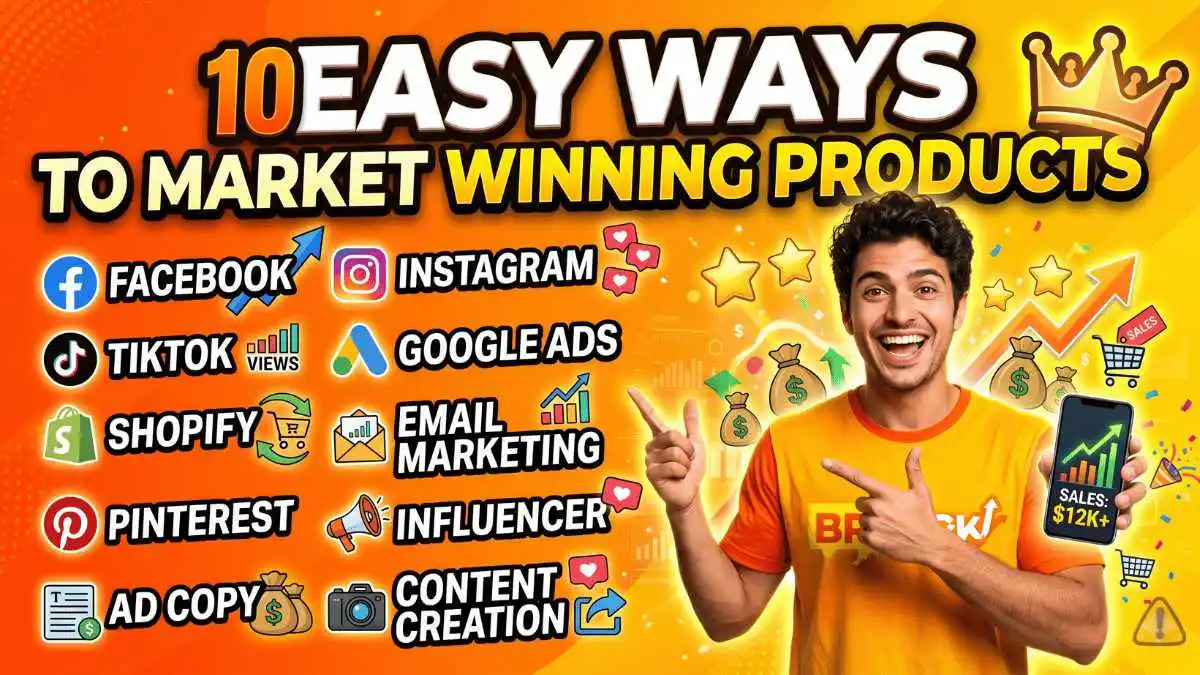
- Why Marketing Is the Multiplier on a Winning Product
- Way 1: TikTok Organic Content (The Free Traffic Engine)
- Way 2: Facebook and Instagram Paid Ads
- Way 3: User-Generated Content (UGC) Ads
- Way 4: Micro-Influencer Partnerships
- Way 5: TikTok Shop and In-App Checkout
- Way 6: Email Marketing and Abandoned Cart Recovery
- Way 7: Pinterest Organic and Promoted Pins
- Way 8: YouTube and Short-Form Video Reviews
- Way 9: Retargeting Campaigns Across Platforms
- Way 10: Product Bundles and Upsell Offers
- All 10 Methods at a Glance: Comparison Table
- Find the Right Product Before You Market It
- Final Thoughts
Finding a winning product is only half the job. The other half is putting it in front of the right people at the right time with the right message. Thousands of dropshippers fail every year not because they chose bad products, but because they had no clear strategy for getting those products seen. In 2026, with competition at an all-time high and ad costs rising across every platform, having a diverse, intelligent marketing approach is no longer optional. It is the entire game.
The good news is that marketing a winning product is significantly easier than marketing a mediocre one. A product that already has a clear value proposition, a strong wow factor, and proven demand gives your marketing efforts a foundation to build on. The 10 strategies in this guide are practical, proven, and accessible regardless of your current budget or experience level. Whether you are launching your first test campaign or scaling a store that already converts, at least several of these methods will apply directly to where you are right now.
Before investing in any marketing channel, make sure you have a genuinely validated product. The best marketing in the world cannot save a product that does not meet the core criteria of a winner. If you are not sure whether your product qualifies, read our guide on what makes a product a winning product before continuing.
Way 1: TikTok Organic Content (The Free Traffic Engine)
TikTok has fundamentally changed product marketing for dropshippers. Unlike every other major platform, TikTok's algorithm actively distributes new content to non-followers based on relevance and engagement signals rather than follower count. This means a brand new account with zero subscribers can publish a product video today and have it reach tens of thousands of people by tomorrow morning, completely free of charge.
The key to organic TikTok success is understanding what the platform rewards. Polished, ad-like content consistently underperforms. Videos that feel native to the platform, raw, real, filmed on a phone, showing a product doing something genuinely useful or surprising, are what drive views, saves, and link clicks. The optimal structure for a product video is a strong hook in the first two seconds, a clear product demonstration or transformation in the middle, and a direct call to action at the end.
- Before and after transformations showing the product solving a visible problem in real time, like a cleaning gadget, posture device, or kitchen tool
- Unboxing and first impression videos that capitalize on curiosity and the tactile appeal of receiving something new
- Problem-solution demonstrations that open with a relatable everyday frustration and show your product as the immediate fix
- Trend-riding content that uses currently viral sounds, formats, or challenges while featuring your product naturally within the structure
- Comment reply videos responding to viewer questions with product demonstrations, which TikTok's algorithm often boosts significantly
Posting consistency matters more than perfection. Starting with one to three videos per day gives the TikTok algorithm enough data to understand your content type and audience. The most successful organic dropshipping accounts treat every video as a test, doubling down on formats that gain traction and moving on quickly from ones that do not.
Pro tip: Use Minea's TikTok adspy to study the top-performing organic and paid TikTok videos for your product category before creating your own content. Analyzing what hooks, formats, and calls to action are already working saves you weeks of trial and error.
Way 2: Facebook and Instagram Paid Ads
Despite being one of the most established advertising channels in ecommerce, Facebook and Instagram ads remain the highest-volume, most scalable paid marketing option available to dropshippers in 2026. The Meta advertising ecosystem gives you access to over three billion monthly active users with the most sophisticated interest, behavioral, and lookalike targeting available on any platform. When you have a validated product and a compelling creative, paid Meta ads can take you from a few hundred dollars in daily revenue to thousands faster than any other channel.
The starting point for any Facebook ad campaign is the creative. Video ads consistently outperform static images for product-based campaigns, particularly for items with a demonstration component. The first three seconds of the video must communicate a clear benefit or trigger curiosity strongly enough to stop the scroll. Everything after those three seconds is working to convert someone who is already interested.
- Start with a $50 to $100 daily test budget split across three to five ad creatives with the same targeting to identify your best-performing angle before scaling
- Use broad targeting initially rather than over-segmenting interests, as Meta's AI has become significantly better at finding buyers autonomously with minimal targeting input
- Study winning ad angles with Minea before writing your own copy by analyzing the best-performing competitor ads for your product category
- Run Advantage Plus Shopping Campaigns, Meta's AI-optimized campaign type that automates creative testing and audience delivery for ecommerce advertisers
- Scale winning ads gradually, increasing the budget by no more than 20 to 30 percent every 48 hours to avoid disrupting the algorithm's learning phase
Way 3: User-Generated Content (UGC) Ads
User-generated content has become the single most effective ad creative format across all social platforms in 2026. UGC refers to video or photo content that looks like it was created by a real customer rather than a brand, filmed on a phone, featuring natural lighting, authentic reactions, and unscripted language. Research consistently shows that UGC-style ads generate four times higher click-through rates than brand-produced content and build trust at a level that polished ads simply cannot replicate.
The reason UGC performs so well is psychological. Ninety-two percent of consumers trust recommendations from other people over direct advertising, and UGC delivers exactly that perception even when it is purpose-built creative rather than spontaneous customer content. On TikTok specifically, UGC-style content generates approximately 35 percent higher watch-through rates than professional ad formats, which directly translates to lower cost per acquisition.
You do not need an existing customer base to start creating UGC. Platforms like Fiverr and the TikTok Creator Marketplace connect you with professional UGC creators who specialize in making product videos that look and feel exactly like authentic customer content. For a budget of $50 to $150 per video, you can have a library of high-converting UGC ads ready to test across multiple platforms within days.
Once you identify your best-performing UGC creative, scale it aggressively. Run it as a paid TikTok Spark Ad to amplify its organic-feeling reach. Whitelist it through your Meta ads manager to run it as a Facebook ad. Submit it as an Instagram Reel ad. A single high-converting UGC video can serve as the foundation of a multi-platform marketing campaign that generates consistent revenue across channels simultaneously.
Way 4: Micro-Influencer Partnerships
Micro-influencers, defined as creators with between 10,000 and 100,000 followers, have become one of the most cost-effective marketing channels available for dropshipping brands in 2026. Unlike mega-influencers with millions of followers, micro-influencers typically maintain highly engaged niche audiences who trust their recommendations at a personal level. Their audiences are smaller but more targeted, and their conversion rates for product recommendations consistently outperform those of larger accounts.
The typical cost for a sponsored post from a micro-influencer in a product-relevant niche ranges from $100 to $500 per post, depending on engagement rates and audience size. For that investment, you receive authentic, organic-feeling content delivered directly to an audience that already trusts the creator's opinion. If the product resonates, the sales generated can easily return five to ten times the cost of the partnership in a single campaign.
- Find niche-relevant creators, not general lifestyle accounts. A kitchen gadget converts better with a food content creator than a general lifestyle vlogger, even if the lifestyle account has a larger audience.
- Offer a commission structure alongside the flat fee. Giving influencers a personalized discount code plus a percentage of sales they drive creates ongoing motivation to promote your product beyond a single post.
- Request video content, not static images. Short-form video consistently outperforms photos for product discovery on every social platform in 2026.
- Ask for content usage rights. Any UGC created by the influencer can be repurposed as a paid ad creative, multiplying the value of a single partnership into a full ad library.
- Start with free product seeding for nano-influencers with fewer than 10,000 followers before moving to paid partnerships, as many creators in this tier will post authentically in exchange for a free product they genuinely find interesting.
Way 5: TikTok Shop and In-App Checkout
TikTok Shop has emerged as one of the highest-converting ecommerce channels of 2026. By allowing users to complete a purchase without ever leaving the TikTok app, it eliminates the friction that kills most impulse-buy conversion funnels. Standard TikTok ad campaigns that send traffic to external websites average around 1.9 percent conversion rates. TikTok Shop in-app checkout regularly achieves conversion rates of 10 percent or higher on the same products, simply by removing the extra steps between desire and purchase.
Setting up a TikTok Shop account is free and connects directly to your existing product catalog. Once live, your products can be tagged in organic videos, live streams, and paid ads with a direct buy button. When a viewer taps the product tag during a live stream or video, they complete the entire checkout process inside TikTok using saved payment details. The combination of entertainment-driven discovery and frictionless checkout is the most powerful conversion mechanism currently available to dropshippers at scale.
TikTok Live Commerce: In markets like the United States and Southeast Asia, TikTok Live shopping sessions are driving extraordinary conversion rates. A 30 to 60 minute live stream where you demonstrate and discuss a product in real time, while viewers can purchase with a single tap, consistently outperforms every other content format for immediate revenue generation. You do not need thousands of followers to start. Even small accounts can generate meaningful live sales with the right product.
Way 6: Email Marketing and Abandoned Cart Recovery
Email marketing remains one of the highest return-on-investment channels available to any ecommerce business, with average returns of $36 to $42 for every dollar spent on well-executed campaigns. For dropshippers specifically, email serves two critical functions: recovering revenue from customers who nearly bought but did not, and generating repeat purchases from people who already did. Both of these outcomes are far cheaper to achieve than acquiring new customers through paid advertising.
The most immediate and highest-impact email automation you can implement is the abandoned cart sequence. Industry data consistently shows that 70 percent of online shopping carts are abandoned before purchase. A well-timed three-email sequence sent over 24 to 48 hours after an abandoned cart event recovers between 5 and 15 percent of those lost transactions on average. At the volume of a scaling dropshipping store, that recovery rate translates directly into significant incremental revenue that requires no additional ad spend to generate.
- Abandoned cart sequence (3 emails over 48 hours): Email 1 reminds them what they left. Email 2 adds urgency with low stock messaging. Email 3 offers a 10 percent discount to close the sale.
- Post-purchase follow-up (2 emails over 7 days): Email 1 confirms the order and sets delivery expectations. Email 2 asks for a review and introduces a related product as an upsell.
- Welcome series for new subscribers (3 emails over 5 days): Introduces your brand, highlights your bestselling product, and delivers a welcome discount code to incentivize a first purchase.
- Win-back campaign for inactive subscribers (1 to 2 emails): Re-engages customers who have not purchased in 60 or more days with a limited-time offer tied to a new product or seasonal promotion.
Way 7: Pinterest Organic and Promoted Pins
Pinterest is one of the most underutilized marketing channels in dropshipping and simultaneously one of the highest-intent platforms available. Unlike TikTok or Instagram where users scroll passively for entertainment, Pinterest users are in a planning and discovery mindset. They are searching for ideas, solutions, and products to buy. The platform's search-driven, evergreen content model means that a well-crafted pin for a home decor product can continue generating traffic and clicks for months or even years after it was originally posted.
Pinterest works best for product categories with strong visual appeal and broad lifestyle relevance, including home decor, kitchen products, fitness gear, fashion accessories, garden items, and beauty tools. For these niches, a Pinterest presence can generate consistent free organic traffic that compounds over time without the daily content pressure of TikTok or the ongoing ad spend of Facebook.
Use Minea's Pinterest adspy to analyze what visual formats and messaging styles are performing best for your product category before creating your own pins. This research step alone can dramatically improve the click-through rate of your Pinterest content from day one, as you are building on proven creative frameworks rather than guessing from scratch.
Way 8: YouTube and Short-Form Video Reviews
YouTube occupies a unique space in the product marketing ecosystem because it serves both discovery and research purposes simultaneously. A potential buyer who sees your product on TikTok and wants to learn more before purchasing will often go to YouTube to find a detailed review, demonstration, or comparison video. If that content does not exist, or if it exists only from competitors, you have lost a customer who was already interested in what you sell.
YouTube Shorts, the platform's short-form vertical video format, has grown significantly in 2026 and offers a discovery mechanism similar to TikTok for product demonstrations. Shorts are distributed to non-subscribers based on topic relevance and engagement, making them an effective free traffic source for dropshippers who want to capture YouTube's search-driven audience without the production investment of long-form content.
For longer-form YouTube content, consider reaching out to mid-sized product review channels in your niche and offering a free product in exchange for an honest review. A 5 to 10 minute YouTube video reviewing a product can rank in Google search results for years and continue sending warm, high-intent traffic to your store long after the video is published. The combination of organic YouTube search traffic and TikTok discovery traffic creates a multi-channel presence that is far more durable than single-platform dependence.
Way 9: Retargeting Campaigns Across Platforms
Retargeting is the practice of showing ads specifically to people who have already interacted with your brand, whether by visiting your product page, watching a certain percentage of your video ad, or adding an item to their cart without completing the purchase. These audiences convert at dramatically higher rates than cold traffic because they have already demonstrated interest in what you sell. Retargeting campaigns typically achieve two to four times the return on ad spend of acquisition campaigns targeting new audiences.
The key to effective retargeting is segmentation. Not everyone who visited your website deserves the same follow-up message. Someone who spent 30 seconds on your product page is less engaged than someone who added to cart. Someone who added to cart is less engaged than someone who started checkout. Building separate retargeting audiences and ad sets for each level of engagement, and tailoring the message accordingly, produces significantly better results than a single blanket retargeting campaign.
- Video viewers (25 to 75 percent watch time): Show a product-focused ad with social proof elements like review counts and star ratings to move warm video viewers toward the product page
- Product page visitors (last 14 days): Show dynamic product ads featuring the exact product they viewed, paired with urgency messaging like limited stock or a time-limited offer
- Add-to-cart without purchase (last 7 days): Show an ad with a small discount or free shipping offer as the primary incentive to complete a purchase they already considered seriously
- Past purchasers (last 90 days): Show ads for complementary products or a new product launch to capitalize on existing trust and generate repeat purchase revenue at minimal acquisition cost
Way 10: Product Bundles and Upsell Offers
Bundling related products together and presenting upsell offers at the point of purchase is not typically thought of as a marketing strategy, but it is one of the most powerful levers available for increasing revenue without increasing your advertising spend. When your average order value rises, every dollar you invest in traffic generates more revenue, which means you can afford to spend more on ads than competitors selling the same product individually, giving you a genuine competitive advantage in any auction-based advertising system.
A well-constructed product bundle groups items that solve the same broader problem or serve the same use case. A customer buying a posture corrector might also benefit from a lumbar support cushion and a desk stretching guide. A customer buying a kitchen gadget might naturally want the complementary accessories that make the primary product more effective or versatile. Presenting these as a bundle at a slight discount compared to individual pricing creates a higher-value offer that improves conversion rates while simultaneously raising average order value.
The post-purchase upsell is one of the highest-converting offers in ecommerce because it appears immediately after a customer has already committed to buying. They are in a buying mindset, their payment details are already entered, and adding one more item requires minimal additional friction. A post-purchase upsell for a complementary product at a 20 to 30 percent discount regularly converts at 15 to 25 percent, generating significant incremental revenue from customers you have already paid to acquire.
Find Products Worth Marketing with Minea
Every one of these strategies works best when the underlying product is already validated. Use Minea's free trial to find your next winner before spending a dollar on ads.
Get My Minea Coupon CodeAll 10 Methods at a Glance: Comparison Table
Here is a summary of all 10 marketing methods, their estimated cost to start, their primary strength, and the type of dropshipper they are best suited for.
| Marketing Method | Cost to Start | Primary Strength | Best For |
|---|---|---|---|
| TikTok Organic | Free | Viral reach with zero ad spend | Beginners, low-budget sellers |
| Facebook and Instagram Ads | $50 to $100/day | Scalable, precise targeting | Intermediate to advanced sellers |
| UGC Ads | $50 to $150 per video | Highest CTR and trust signals | All levels, especially TikTok and Meta |
| Micro-Influencer Partnerships | $100 to $500 per post | Niche audience trust and reach | Visual and lifestyle product categories |
| TikTok Shop | Free to set up | 10% plus in-app conversion rates | Sellers with impulse-buy products |
| Email Marketing | $20 to $50/month (tools) | Abandoned cart recovery and repeat sales | Stores with existing traffic |
| Pinterest Organic | Free | Evergreen, intent-driven traffic | Home, kitchen, beauty, and lifestyle niches |
| YouTube Reviews | Free (product cost for seeding) | Long-tail search traffic for years | Products with complex value propositions |
| Retargeting Campaigns | $10 to $30/day minimum | 2 to 4x higher ROAS than cold traffic | Stores with existing website traffic |
| Bundles and Upsells | Free (Shopify app) | Higher AOV without extra ad spend | All levels, highest ROI multiplier |
Find the Right Product Before You Market It
Every strategy in this guide becomes dramatically more effective when applied to a product that already has genuine market demand, a clear wow factor, and proven profitability in competitor advertising. A weak product placed in front of the right audience with the right message will still underperform. A strong product, even with imperfect marketing, will generate sales because the fundamental pull already exists in the market.
The most reliable way to identify products with that level of built-in demand is to use a dedicated product research and adspy platform. Minea is the tool we recommend for this because it covers Facebook, TikTok, and Pinterest in one dashboard, giving you the cross-platform validation data that separates genuine winners from short-term spikes. The AI Magic Search feature lets you find every competitor currently advertising any product you discover, and the Trending Shops tool shows you the real Shopify stores generating the most revenue from the ads you are analyzing.
If you are not already using an adspy tool as part of your product research workflow, start with Minea's free trial. The 200 complimentary credits require no credit card and give you enough data to validate your first product concept thoroughly before committing to paid advertising. Read our full breakdown of Minea's free trial versus paid plans to understand exactly which tier makes sense for where you are right now.
Validate Your Product with Minea Before Marketing
Use Minea's TikTok, Facebook, and Pinterest adspy to confirm that multiple advertisers are running long-term campaigns for your product. This is your clearest signal that the product converts and that the marketing channels you plan to use have already proven effective for it.
Start with Organic TikTok to Test Your Angle for Free
Before spending any money on paid ads, post three to five organic TikTok videos using different hooks and creative formats. The content that generates the most comments, saves, and shares tells you which angle resonates most with your target audience before you invest in scaling it.
Invest in at Least Two UGC Creatives
Commission one to two UGC-style video ads from a creator platform before launching paid campaigns. UGC dramatically outperforms branded creative on both TikTok and Facebook, and having multiple creatives to test from day one accelerates the process of identifying your winning ad.
Launch Paid Ads on Facebook or TikTok with a Clear Test Budget
Set a defined test budget of $200 to $500 per product before making any scaling decisions. If the product generates a positive return on ad spend within that budget, scale incrementally. If it does not, the data you collected on what did not work is still valuable for your next test.
Add Email Flows and Retargeting to Compound Your Results
Once you have a converting product and paid channel, implement abandoned cart emails and retargeting campaigns immediately. These two additions can increase your effective revenue from the same ad spend by 20 to 40 percent without any additional creative investment.
Final Thoughts
Marketing a winning product is a compounding process. Each channel you add, each creative format you test, and each automation you implement builds on the others. A dropshipper who is active on TikTok organically, running Facebook ads with UGC creatives, recovering abandoned carts via email, and retargeting past visitors has five separate systems generating revenue simultaneously from the same product. That redundancy and reach is what separates a store generating five figures per month from one still struggling to hit its first consistent week of sales.
The ten methods in this guide cover the full marketing funnel, from initial discovery through conversion, recovery, and repeat purchase. You do not need to implement all ten at once. Start with the channels most suited to your budget and product type, master them, and then layer on additional strategies as your revenue grows. Every successful ecommerce store started exactly where you are now.
And before any of these strategies, make sure you are working with the right product. Use our exclusive Minea promo codes to start your product research at the lowest possible price, and read our guide on what makes a product a winning product to ensure every item you choose to market is already set up for success.
Start Your Free Minea Trial and Find Your Next Winner
200 free credits, no credit card required. Use our exclusive coupon code to save up to 50% when you upgrade to a paid plan.
Claim My Minea Discount